Stop Battery Energy Storage Systems (BESS) and High Voltage Cables on Long Island
Stop Battery Energy Storage Systems (BESS) and High Voltage Cables on Long Island
Here are two videos that really bring home the risks of the Propel Project.
A high voltage, underground transmission project, similar to Propel (CHPE), is turning Rockland County into a nightmare for residents and businesses. The events in Rockland are just one reason why we object to the Propel project, but they are incredibly important.
Not suprisingly, promises made prior to construction are not being kept. The models projected that the risks to local businesses were minmal, but here are real world results and they aren't pretty. Traffic is a contining nighmare, customers and employees can't get to local businesses, local schools are disrupted becasue buses cannot arrive on time. The construction work proceeds virtually 24/7 with no regard for the noise and pollution it creates. Residents are left with only small snippets of peace and quiet.
We encourage you to watch these videos and do TWO THINGS:
1) Be thankful that it is not in your backyard (yet), and
2) Pick up the phone and call all your local politicians and DEMAND that they do not allow this to happen here. If they fail, never vote for them again - EVER!
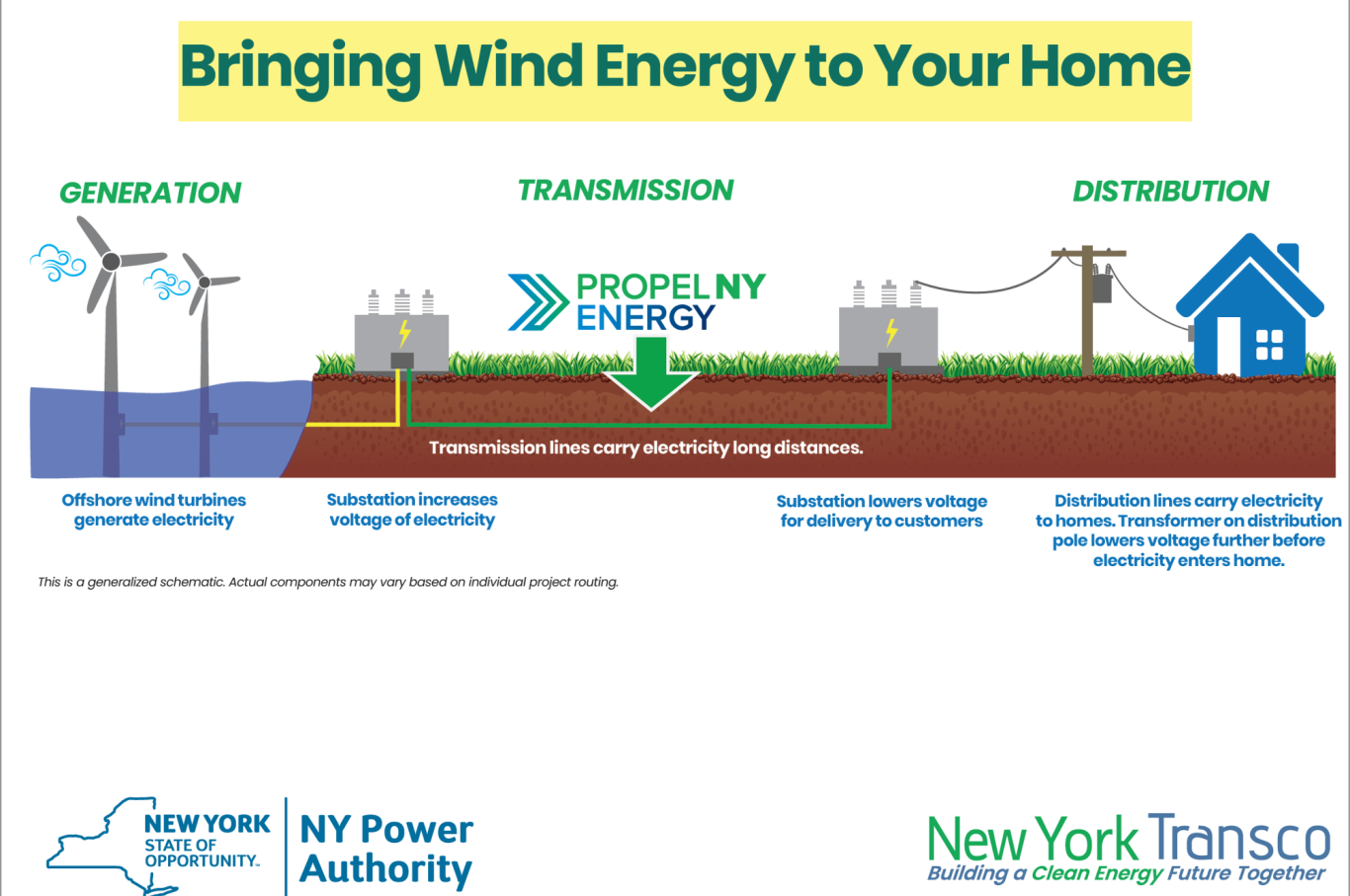
Propel continues to say that this project is unrelated to windmills or BESS facilities, but the saying at the top of the picture tells it all. "Bringing Wind Energy to Your Home"
Transmission lines connect power sources (powerplants, windmills, batteries) with the distribution network (the power lines to homes and businesses). Why do we need this change? Because the sources are moving from onshore powerplants to offshore windmills. That change requires a whole new 'backbone' to move all the excess power to upstate New York.
The windmills in the Atlantic will be sending power all the way upstate and connect with similar projects to interconnect all of NYS. If the power sources didn't change location, much of this would be unnecessary, although the existing infrastructure is getting old.
The sales pitch is that this project will improve 'resiliency'. The reality is that our power infrastructure, while aging, is still quite resilient, but as we replace that fossil fuel capacity with windmills and other renewable sources, we need more resiliency because the wind doesn't always blow and the sun doesn't always shine. As we show in Green Energy Honesty, the nameplate renewable capacity that must be added can be roughly 9X the amount that we retire, and about 10 times the cost of an efficient combined cycle gas plant, and that cost doesn't even include the cost of these new transmission wires or the battery facilities required to operate renewable energy. If you think this is going to save you money on your electric bill, think again.
Don't believe us? Here is what a Wall Street Journal Editorial stated:
"New York state signed a contract in June to buy electricity generated by two large wind farms, Empire Wind 1 and Sunrise Wind, off the coast of Long Island. The projects are expected to begin in 2026 and 2027, with power delivered to Brooklyn (Empire) and Long Island (Sunrise). The state will pay $155 and $146 per megawatt-hour, respectively. These prices are steep, at least four times the average grid cost paid over the past year. New Yorkers should be asking why." Why Is New York Paying So Much for Wind Power? Aug. 23, 2024
And Politico has this to say: "The cost to consumers of two offshore wind projects expected to support New York’s climate goals has more than doubled". Offshore wind costs double for consumers as New York keeps early projects on track
Here's some math: 1 MWh = 1000 kwh. If NYS state is paying $150 per MWh, it is paying 15 cents per kwh. Now compare that to your electric bill. According to PSEG, the PSC rate for January 2025 was $0.124047/kWh. New York has made the ridiculous decision to actually pay more for wind power than we currently pay! Exactly how do they expect electric bills to go down?
The answer is easy. They don't expect our electricity costs to go down, they expect us to be unaware of the change until it is too late.
If you live or have a business near these Propel lines, you have other concerns.
The first is electromagnetic radiation. In some areas, like in the Glen Head/Glenwood Landing area, a single 35 foot wide road is planned to have two 345,000 volt lines and one 138,000 volt line. That is 828,000 volts constantly traveling along one relatively narrow road lined with small businesses and residences.
They say EMFs (electro-magnetic radiation) are not harmful, yet New York State limits exposure to electromagnetic fields (EMFs) around transmission lines to 200 milligauss (mG). This limit applies to the edges of rights-of-way for major transmission lines. Preliminary project documents indicate that exposure could be above that threshold (230 milligauss) in the Glen Head/Glenwood Lnading area. There is plenty of concern that our cell phones are exposing us to too much EMFs. What is safe and what isn't safe? It's hard to know, because sensitivity to EMFs varies from individual to individual. The video above discusses some of these problems. The bottom line is that given a choice to live with high EMF's are low EMFs, which would you choose? If you'd choose the lower EMF location, then threre is a likelihood that real estate values could be affected by these high voltage wires.
But that's not all. These high voltage lines have to be installed underground, all across Long Island. We all know how horrible Long Island traffic can be, what happens when these major roadways are dug up to install these wires?
Traffic snarls will become exponentially worse
Local businesses, already suffering from on-line retail and COVID, will be interrupted, and
Emergency services will have even more trouble responding to fires and other emergencies.
The more you look at these projects, the more you have to ask, what is in it for us??
Letters
May 29, 2025
To the Editor:
Re Rory Christian’s op-ed, “Local voices matter, and the RAPID Act listens,” in the May 15-21 issue: The irony is hard to ignore. Indeed, local voices do matter — but clearly not to Mr. Christian. The proper channel for those voices is through local elected representatives at the county, town and village levels, yet his actions and advocacy say otherwise.
As chairman of the New York State Public Service Commission, Mr. Christian oversees the electric, gas, water and telecommunications sectors, with a staggering annual budget of $117.5 million and a staff of 528. Despite this immense responsibility, he chose to chastise town supervisors for voicing legitimate concerns about the Renewable Action through Project Interconnection and Deployment Act — a law that warrants scrutiny, not silence.
Contrary to Mr. Christian’s endorsement, the RAPID Act undermines the authority of local governments by stripping them of the ability to conduct rigorous planning and environmental reviews of energy storage projects, including battery energy storage systems. While the state regulates major energy infrastructure through the Article VII process, the RAPID Act creates a back door: If a BESS project is collocated with an existing transmission facility or renewable energy installation, it can bypass local oversight entirely.
This fast-tracking mechanism denies communities any meaningful environmental review — ignoring cumulative impacts and serious risks. Local governments are on the front lines, assessing how these projects affect neighborhoods, schools, sole-source aquifers, waterways, and public health and safety. Their role is indispensable.
In Oyster Bay, several stand-alone BESS projects have been proposed. Fortunately, they’re currently on hold due to the town’s prudent decision to enact a moratorium. But it wouldn’t surprise anyone if those proposals are quietly withdrawn, repackaged and collocated with projects like Propel or offshore wind facilities — effectively circumventing local review by exploiting the RAPID Act.
Energy storage systems come with serious risks — long-term and cumulative. Fires involving lithium battery units are notoriously difficult to extinguish. High-voltage underground cables from projects like Propel emit electromagnetic fields and carve through residential neighborhoods. These are not abstract concerns. They are real and pressing, and local governments are best positioned to evaluate them thoroughly and responsibly.
Mr. Christian accuses town supervisors of undermining progress. In reality, they are fulfilling their duty: protecting their communities. It’s the PSC that has consistently failed to listen — to local officials, to residents, and even to members of the State Legislature. Mr. Christian’s invitation to “sit down and talk” rings hollow, because his agency has repeatedly ignored local input.
Worse still, the PSC makes it prohibitively difficult for communities to participate. Take the current Propel application: Intervenor funding under Article VII is woefully inadequate, failing to cover the expert analyses necessary for proper review. If that project opts into RAPID, there will be no intervenor funding at all — just an accelerated timeline with even fewer opportunities for public engagement.
At a February PSC hearing, an administrative law judge stated that the RAPID Act is designed to “simplify and accelerate” renewable energy development. But speed must not come at the expense of safety, transparency and sound planning. Convenience for developers cannot outweigh community well-being.
Mr. Christian claims that the PSC values transparency and community input. But the agency’s history — especially regarding LIPA, PSEG-LI, American Water and Liberty Water — tells a very different story. Long Island may indeed need to diversify its energy sources, but how and where that happens must be decided locally, by the people and their elected representatives. That’s what democracy demands.
The RAPID Act is nothing less than an end-run around local government. It invites the state to override zoning laws, environmental protections and planning procedures. And the ripple effect won’t stop at energy — it opens the door to growth-inducing developments of every kind, from commercial sprawl to high-density housing, all at the expense of the very communities the law purports to serve.
Local voices do matter. But actions speak louder than headlines.
MICHAEL MONTESANO
Glen Head
The author represented the 15th Assembly District from 2010 to 2022.
We need your consent to load the translations
We use a third-party service to translate the website content that may collect data about your activity. Please review the details in the privacy policy and accept the service to view the translations.